How to Size a Soft-Pack Battery from Device Power Consumption (Engineering Guide)
Convert sleep, idle, active, and transmit mode currents into average watts and required Wh, then check peak current and PCM separately. Map the budget sheet to a quote-ready soft-pack spec and validate with paid samples.
October 30, 2026Green BatteryAbout 11 min read
Green Battery Insights
Answer first:How do I calculate how large a LiPo my device needs? Estimate average power from each operating mode’s current and time share, convert to watt-hours for the target runtime, then increase nominal energy for conversion loss, cutoff, temperature, and aging allowances you document. Separately verify that the cell and PCM can supply peak current without sag that resets the product. Turn the same fields into a custom soft-pack RFQ and prove the duty cycle with paid samples.
Why isn’t mAh enough for an OEM battery spec? mAh is charge capacity at a stated condition. Runtime and pack energy depend on voltage and load. Two packs with the same mAh at different voltages store different Wh; peak current capability is not shown by mAh alone. Green Battery’s FAQ already states Wh = V × Ah and a simple runtime ≈ Ah / A (real runtime is often shorter because of efficiency, temperature, aging, and cutoff). OEM specs should list Wh, continuous/peak current, and mechanical envelope together.
What power numbers belong on a custom battery RFQ? Nominal and charge voltage window, required Wh or mAh at a stated voltage, continuous and peak discharge current (with pulse width if known), operating and charge temperature, mechanical max size, connector, and whether the sample must prove runtime under a defined duty cycle.
This page is an original technical analysis for OEM/ODM teams sizing custom 3.7 V pouch (soft-pack) LiPo for portable CE, wearables, IoT, compact cameras, and selected medical devices. Site FAQ formulas are marked FAQ; Green Battery commercial claims V; worked numbers C (illustrative engineering estimate); general practice G. Nothing here is a Green Battery lab discharge curve for a named end product.
Sister topic (do not cannibalize): the draft-local article edge-ai-hardware-lipo-power-budget-pack covers . Cross-link after both are published. stays on general portable-device RFQ math.
AI module TDP, Orin-class input windows, TinyML monitoring, and robot/UAV PACK pulses
This page
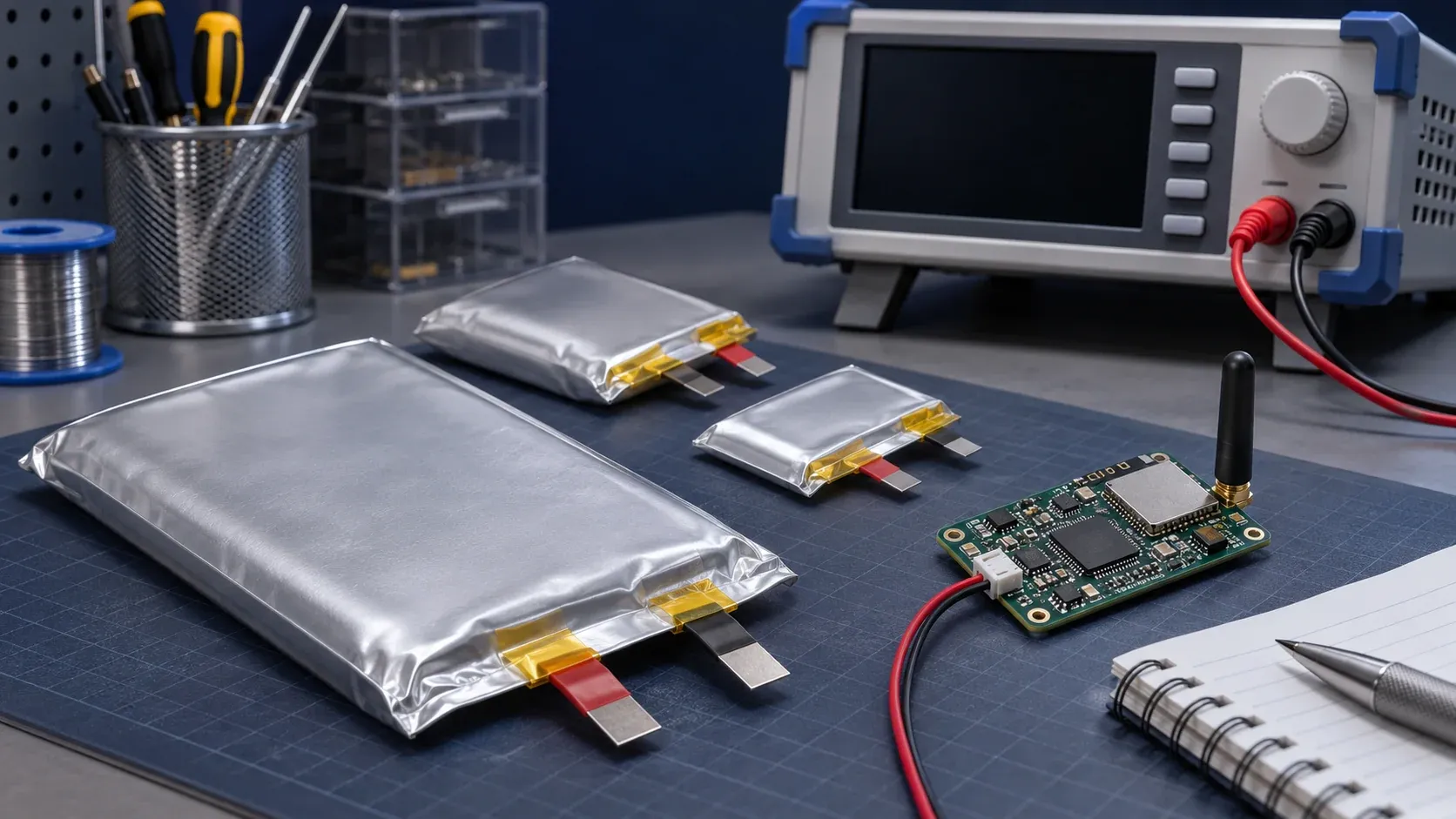
Caption: Illustrative cover, not a measured test. Any numbers printed on the prop spreadsheet are scene props; the duty-cycle tables in this article are authoritative.
1. A power budget is a product document, not a single watt number
Before industrial design locks the battery bay, freeze a spreadsheet that electrical/systems engineering owns and sourcing can reuse:
Document field: Mode list (sleep / sense / active / TX / charge coexistence) | Owner: EE / FW | Why it must exist: Average power comes from dwell, not peak nameplate
Document field: Mode current or power + duty cycle | Owner: EE | Why it must exist: Sets Wh
Document field: Target runtime + use temperature | Owner: PM + EE | Why it must exist: Sets energy and margin policy
Document field: Peak current, pulse width, allowed sag | Owner: EE | Why it must exist: Sets C-rate and PCM
Document field: Regulator topology + efficiency assumption | Owner: EE | Why it must exist: Sets battery-side energy
Document field: Max L×W×T, swell, tab/connector | Owner: ID + EE | Why it must exist: Sets soft-pack feasibility
Document field: Cert markets + rough annual volume | Owner: Sourcing / compliance | Why it must exist: Sets sample and production path
η_reg, f_cutoff, f_temp, and f_aging must be design values written in your document, not mysterious “industry standard percentages.”
Average current from duty cycle:
I_avg = Σ_i (I_i × d_i), Σ d_i = 1
3. Duty-cycle worked example (portable CE / wearable-style IoT)
Numbers below are an illustrative engineering estimate (C)—not a shipping SKU and not a Green Battery lab curve.
Mode: Sleep | Current I (mA @ ~3.7 V rail): 0.08 | Time share d: 90% | Contribution I× d (mA): 0.072
Mode: Sense / shallow idle | Current I (mA @ ~3.7 V rail): 12 | Time share d: 8% | Contribution I× d (mA): 0.960
Mode: Active (MCU + short radio) | Current I (mA @ ~3.7 V rail): 45 | Time share d: 1.8% | Contribution I× d (mA): 0.810
Mode: Burst (LED + radio peak window) | Current I (mA @ ~3.7 V rail): 180 | Time share d: 0.2% | Contribution I× d (mA): 0.360
Mode: Total | Current I (mA @ ~3.7 V rail): — | Time share d: 100% | Contribution I× d (mA): I_avg = 2.202 mA
Caption: Redrawn from this article’s illustrative duty-cycle table; not a measured discharge curve.
Worked steps (C, recalculable):
P_avg = 3.7 V × 0.002202 A ≈ 8.15 mW.
Target runtime T = 72 h (~3 days between charges): E_load ≈ 0.00815 × 72 ≈ 0.587 Wh.
Documented η_reg = 0.88 for this example (designer-chosen path/regulator allowance): E_from pack ≈ 0.587 / 0.88 ≈ 0.667 Wh.
Documented f_cutoff = 0.92, f_temp = 0.90 (includes a cold outdoor allowance chosen by the team), f_aging = 0.80 (EOL capacity target) → product 0.6624.
Wh_nom,min ≈ 0.667 / 0.6624 ≈ 1.01 Wh → about 272 mAh at 3.7 V.
Practical pick: roughly 300–350 mAh class soft-pack if the bay allows, leaving room for swell, PCM, and harness—not an arbitrary “double it.”
Peak is separate: 180 mA for 0.2% of time still requires the cell and PCM to survive the declared pulse width without reset-level sag. Correct average Wh ≠ peak pass.
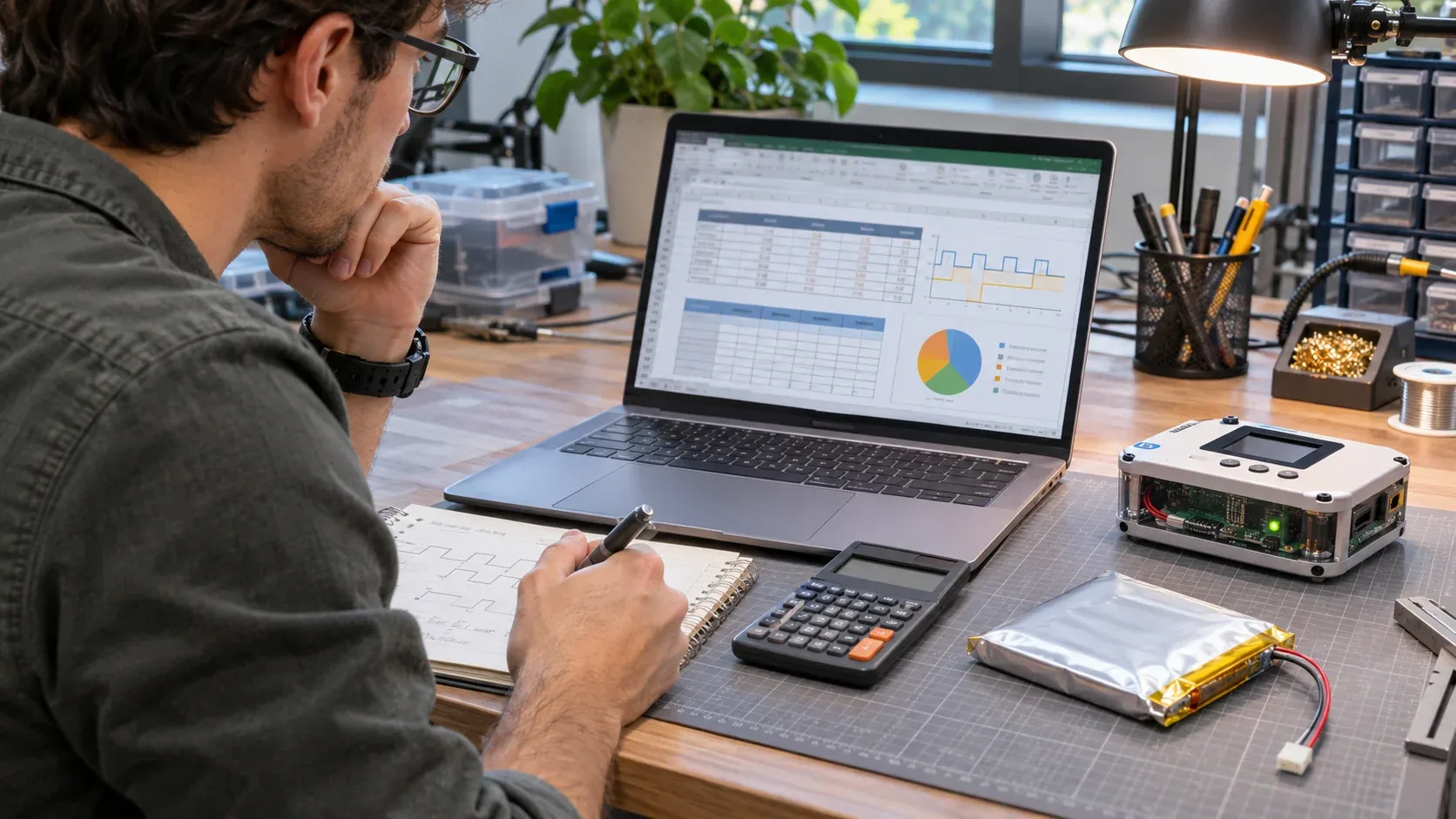
Illustrative engineering scene for translating a duty-cycle power budget into a runtime estimate; no product-specific result is shown.
Average power answers “how long.” Peak answers “will it brown out.”
Situation (G): Wireless bursts / cellular retries | Average may look tiny: Sleep-dominated average | Spec that still fails: TX peaks and mismatch spikes
Situation (G): LED / haptic / flash | Average may look tiny: Short duty | Spec that still fails: Pulse width + allowed Δ V
Situation (G): Camera ISP + focus + Wi-Fi together | Average may look tiny: Record average W is estimable | Spec that still fails: Coincident peaks
Situation (G): Cold start | Average may look tiny: Conservative average | Spec that still fails: Higher impedance → more sag at same amps
On the RFQ, list separately:
Continuous (or sustain) discharge current
Peak current and pulse width (e.g. 180 mA / 50 ms—illustrative wording)
Minimum voltage coordination between load UVLO and pack protection
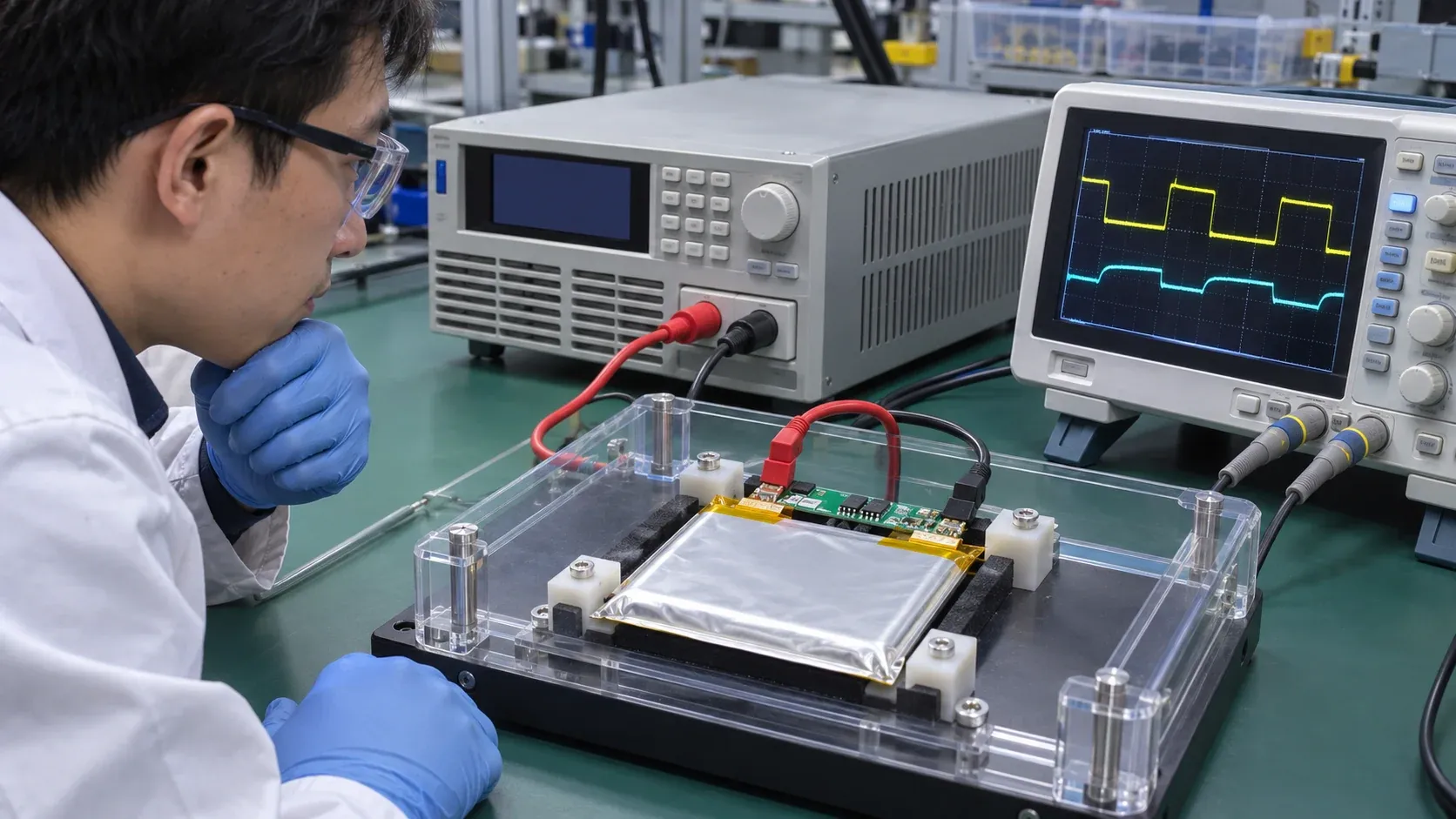
Illustrative pulse and PCM validation setup; this image does not report a pass/fail result.
Measure steady current in sleep, sense, active, and transmit; note whether the probe is on the pack rail or the load rail.
Capture bursts with a shunt, power profiler, or source-measure unit; log width and repeat period.
Weight modes by a real user script or firmware state machine → I_avg / P_avg.
Enlarge Wh only when evidence shows energy shortfall. If the failure mode is undervoltage reset, inspect peak, wiring IR, PCM trip, and hold-up capacitance first.
Spot-check temperature corners before you write f_temp.
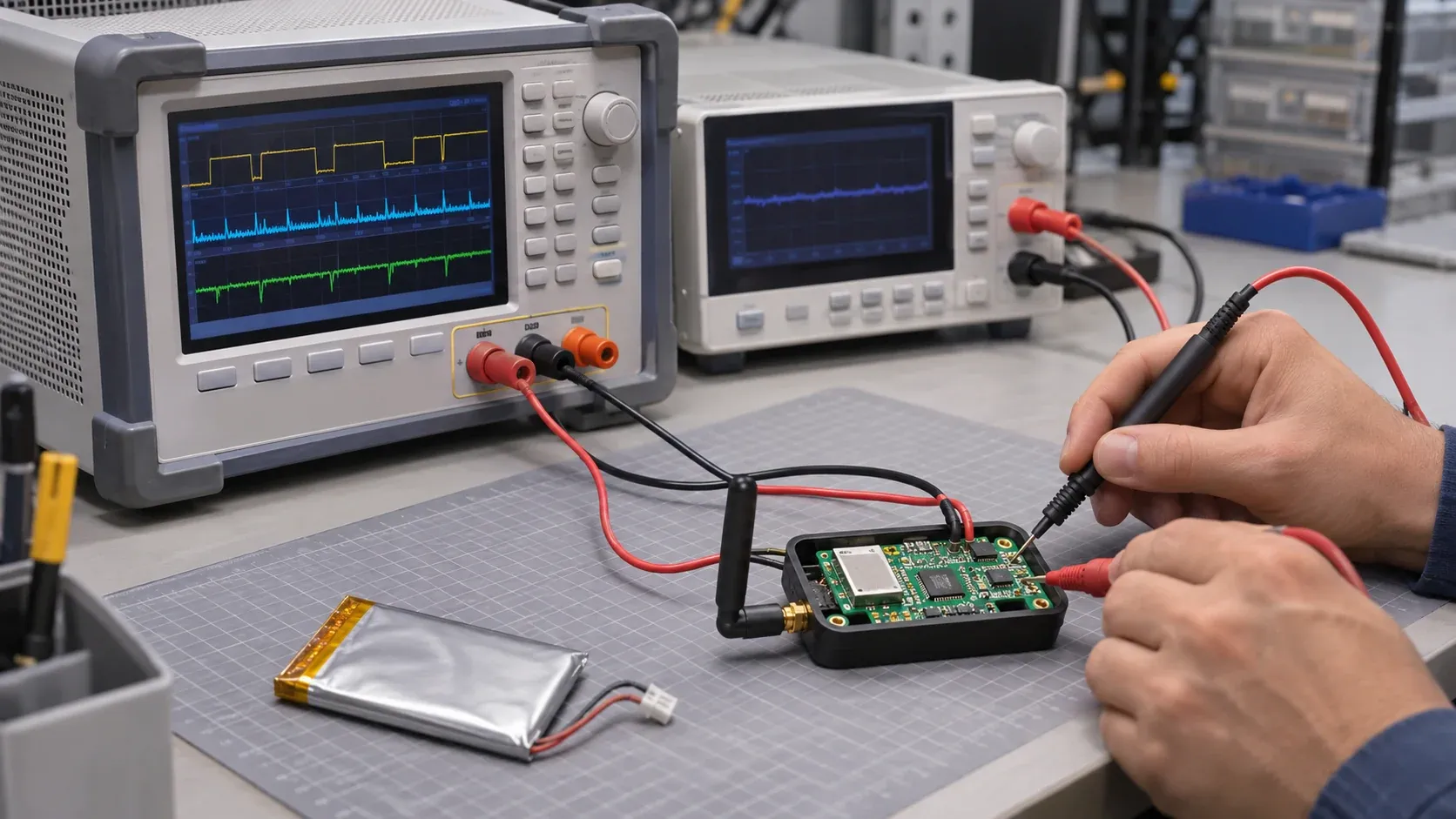
Illustrative bench setup for measuring device operating modes; instrument displays are not a test record.
Growing capacity moves structure, Wh shipping thresholds, and paperwork. Measurement is cost control.
Do not hide undefined “industry 80%” factors in a quote. Split margins (G; values are project-chosen):
Factor: η_reg | Question it answers: How much pack energy reaches the load? | Example in §3 (illustrative only): 0.88
Factor: f_cutoff | Question it answers: How much of nominal energy will you use before protection? | Example in §3 (illustrative only): 0.92
Factor: f_temp | Question it answers: What remains at cold/hot corners? | Example in §3 (illustrative only): 0.90
Factor: f_aging | Question it answers: What fraction of BOL runtime must remain at EOL? | Example in §3 (illustrative only): 0.80
Multiplying them is honesty, not marketing conservatism. If a factor is unknown, mark “TBD—confirm on paid sample,” rather than inventing false precision.
7. From budget sheet to soft-pack RFQ
Caption: Teaching mapping diagram, not a commercial quote form.
Budget / EE sheet field: Mode currents + dwell | Soft-pack RFQ field: Derived continuous / average working current (A)
Budget / EE sheet field: Target runtime (h) + P_avg | Soft-pack RFQ field: Required Wh or mAh at stated V
Budget / EE sheet field: System voltage window / series intent | Soft-pack RFQ field: Nominal and charge voltage window
Green Battery (V / FAQ) customizes dimensions, voltage, capacity, discharge, connector, PCM, and related pack details. Samples exist so teams can validate size, performance, connector, and charging behavior (FAQ). For standard paths, factory-side sample readiness is often discussed as 48–72 hours (ready at the factory—not door-to-door). Plan roughly ~15 days for overseas logistics as a planning window; confirm per project and carrier. Samples are paid technical validation, not free giveaways.
Series raises voltage; parallel raises capacity and current capability; many packs combine both (FAQ). Details live on the site Battery Calculator FAQ—this article does not recreate consumer series/parallel puzzles.
7.2 What not to copy from consumer calculator pages
End-user “calculate watts / battery life” pages usually stop at P=V× I, Wh, and a rough hour estimate. OEMs still need three pieces those pages rarely ship:
RFQ field mapping (mechanics, PCM, pulse width, certs, sample acceptance)
Peak as a first-class constraint (listed beside average Wh)
Paid-sample validation loop under a declared duty cycle—not nameplate mAh alone
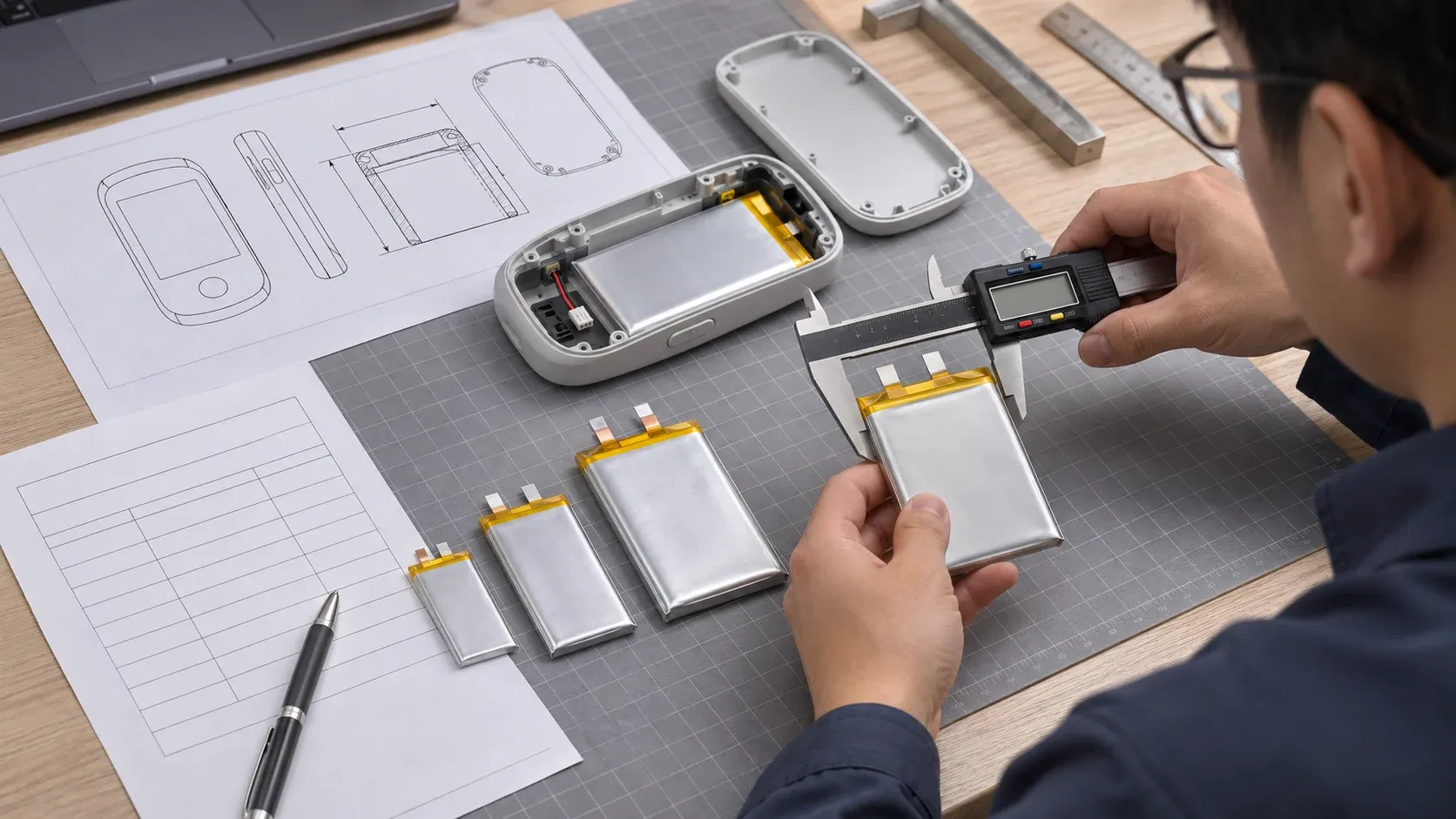
Illustrative form-factor review comparing pouch-cell dimensions with a device enclosure; confirm final fit and performance with project samples.
This guide is built around those three. Generic identities cross-link the on-site FAQ so we do not publish another hollow calculator clone.
8. When to optimize draw vs grow capacity
After Wh is estimated, ask whether cutting load is cheaper, thinner, or easier to certify than growing the cell:
Lengthen sleep, batch radio reports, cut always-on peripherals
Firmware peak-shaving (desynchronize motor and radio)
Raise capacity only when the bay still has room and peak already passes
Camera / outdoor SKUs still deciding native soft-pack vs USB-C accessory power belong to a separate architecture brief (Brief 3) after the budget sheet exists. Action / body / wearable camera cavity and C-rate detail belong to the camera soft-pack brief (Brief 1). High-power edge modules stay on the AI hardware soft-pack draft so keyword intent does not collide with this general RFQ math page.
9. Closing and next step
Build P_avg from duty cycle, then E_load for the runtime SLA.
Measure before changing tooling; never pass rumor “industry %” as fact.
Map budget → RFQ → paid sample acceptance under the same script.
Send mode currents, target runtime, cavity limits, and peak requirements to Green Battery sales engineers for a soft-pack recommendation and paid-sample plan (factory-side sample timing commonly discussed in the 48–72 hour range; international logistics planned separately). Start from the FAQ or special battery / battery pack pages.