

1
Slurry Mixing
Active materials, conductive agents, and binders are dispersed under controlled conditions to produce a uniform, stable coating slurry.
Battery Production Process
A photo walkthrough of the full production flow — from raw electrode slurry to a tested, sealed, and packed battery.
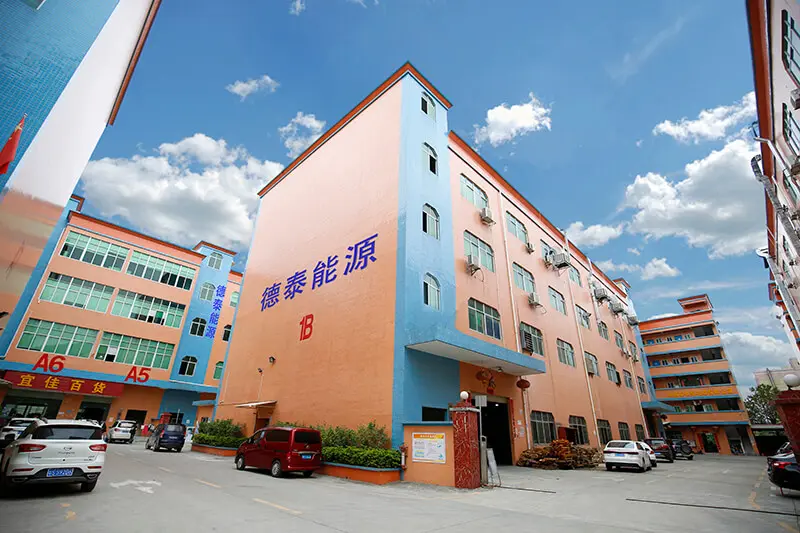
Our Shenzhen and factory offices bring customer communication, engineering coordination, and production support together in one connected team.


A clean, controlled production floor keeps equipment, workstations, and materials organized to support stable cell assembly.


Active materials are processed into precise electrode sheets, creating the consistent foundation for every cell that follows.
Active materials, conductive agents, and binders are dispersed under controlled conditions to produce a uniform, stable coating slurry.

Cathode slurry is applied evenly to aluminium foil while coating weight and thickness are monitored online for consistent electrode capacity.
Graphite-based anode slurry is coated on copper foil, dried, and compacted to create a stable electrode sheet for reliable cycling.
Precision rolls control cathode density and thickness, improving adhesion, pore structure, and energy density.
The anode sheet is compacted evenly to stabilize thickness and surface flatness for accurate downstream assembly.
Automated slitting cuts wide cathode sheets to specification while tightly controlling burrs and edge quality.
Anode sheets are precision-slit and rewound in a clean environment to protect cell safety and consistency.
Prepared electrodes are wound, dried, enclosed, filled, and sealed in a controlled environment to form the cell.

Cathode, separator, and anode layers are accurately wound with real-time tension and alignment control to form a stable cell core.

Vacuum ovens remove residual moisture to ppm-level control, reducing electrolyte side reactions and supporting safe, long-life cells.
Aluminium-plastic laminate is stamped into accurately sized pouch shells with clean edges for dependable cell enclosure.
Electrolyte is filled under low-humidity control at a precise volume so the cell is fully wetted and performs consistently.
Cutting, folding, and heat sealing complete the final pouch enclosure, isolating the cell from moisture and air.
Newly sealed cells are activated, inspected, and graded so that only consistent cells move to the next stage.

The first controlled charge and discharge forms a stable SEI layer; thermal formation activates the cell for cycle life and safety.

Post-formation cells undergo OCV, internal-resistance, and appearance inspection to remove nonconforming units.
Multi-channel charge/discharge equipment grades capacity and performance, enabling tightly matched cells for PACK assembly.
Qualified cells are identified, protected, and stored by batch and model to preserve traceability through shipment.

Qualified cells are marked, labeled, and packed on a traceable line for safe, standardized delivery from the factory.

Cells are stored by batch and model under controlled conditions with FIFO and inventory traceability management.
Cells become complete battery systems, supported by reliability validation and samples for engineering and customer development.

Cells are connected in series and parallel with BMS integration, mechanical assembly, and harness connections for the required battery system.

Cell and PACK products are validated with safety tests such as combustion, drop, temperature cycling, short-circuit, and crush testing.
Battery samples and test data are centrally managed to support product selection, custom development, and failure analysis.
Tell us your voltage, capacity, size, shape, and discharge requirements. Our engineers will recommend a cell format and production route for your application.