
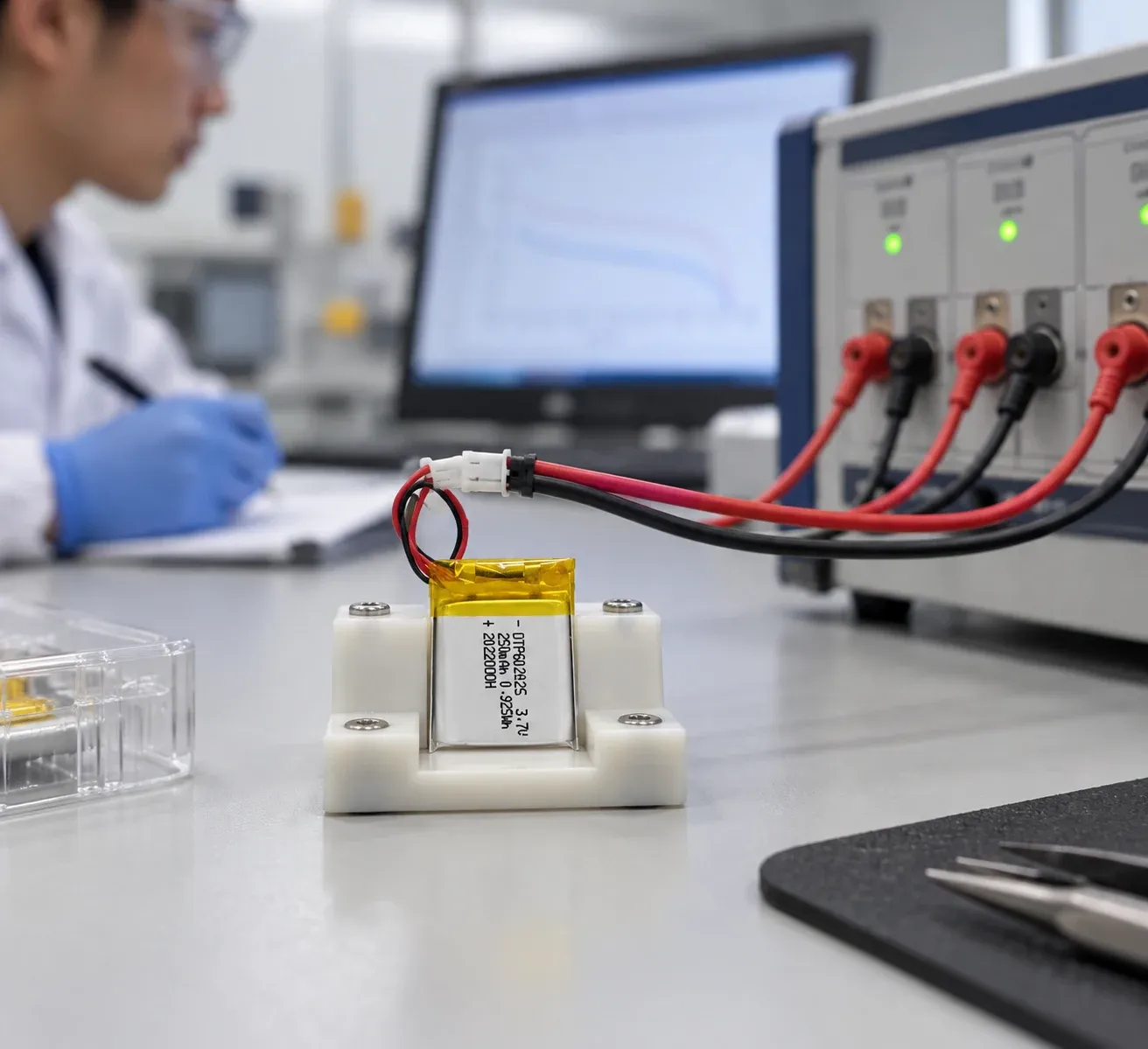
A TWS battery discussion often starts with one question: “How many milliamp-hours do we need in each earbud?” Capacity alone cannot answer it. The cell must fit the usable length, width and thickness, including seal margins, tabs, connectors and assembly clearance. Runtime also depends on listening level, call time, radio activity, standby draw and the charging strategy. A capacity target without those inputs can lead to a cell that either does not fit or cannot support the load.
Measure the cavity before comparing capacities
Share the three-dimensional battery envelope, permitted shape, tab direction, connector location and assembly allowance with the cell supplier. Two cells with similar outer dimensions may not be interchangeable if their sealing margins, tabs or protection components occupy different space. A pouch cell can be shaped around a narrow or irregular cavity. A coin cell can make sense when the enclosure is designed for a fixed round package and its assembly constraints. Neither format is the default winner outside a specific mechanical design.
Describe the load, not just the mAh target
Average playback current, peak current during calls or radio transmission, peak duration and the minimum operating voltage at low state of charge all affect performance. Ask the supplier to assess voltage drop and usable runtime using the proposed cell dimensions and protection circuit. For fast charging, include the charger and power-management design, charge current, temperature limits and operating conditions. A “fast-charge” label or a C-rate by itself does not establish that the cell, protection circuit and product thermal path are compatible. Validate the charge profile and temperature in the final design.
Make safety and pair matching measurable
The cell sits close to the user in a compact enclosure. The specification should state how overcharge, over-discharge, overcurrent, short-circuit and temperature protection will be implemented, and whether the components fit the available space. Include pouch sealing and tab connections in process validation; do not assume manual soldering is suitable without a process review. Transport documents, including an applicable UN 38.3 test summary, should correspond to the exact cell model.