How to Size an IoT Sensor Battery: Sleep Current, Radio Bursts and Service Life
Estimate IoT sensor battery life from the full load profile—not nominal capacity alone. Include radio pulses, circuit quiescent current, self-discharge, temperature, aging and any energy-harvesting input.
September 21, 2026Green Battery Engineering TeamAbout 11 min read
Green Battery Insights
For a sensor on a rooftop, in a meter cabinet or at a remote site, the service visit can cost more than the battery. Define the required interval, reporting schedule, temperature range, charging opportunity and failure response before choosing a cell. A Li-Po pouch cell can suit a thin rechargeable design; a primary cell deserves comparison when charging is unreliable.
Measure the whole operating cycle
List sleep, sensing, processing, radio transmit, receive windows, retries, firmware updates and maintenance. Record current, duration and daily event count for each state. Include regulator and protection quiescent current, pull-ups and board leakage. Sensor data-sheet sleep current is not whole-system sleep current. TI’s duty-cycled sensor analysis explains why frequency and system-level currents matter.
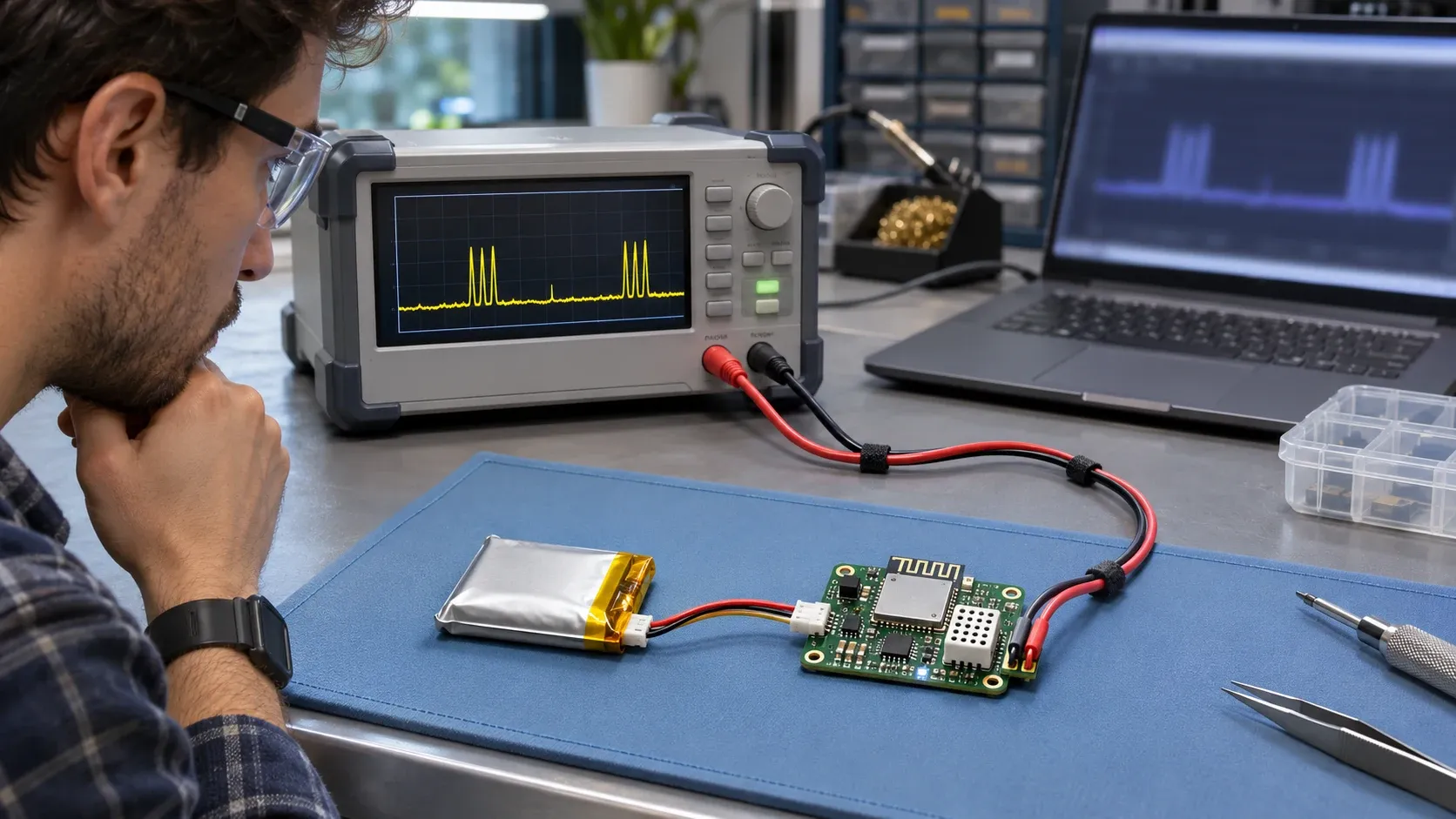
Illustrative whole-node current measurement scene; instrument displays are not a test record.
Record the final hardware and firmware versions, supply voltage, sampling bandwidth, signal conditions, reporting interval, temperature and sample count. Use an instrument that captures both microamp sleep and short milliamp peaks. Nordic’s Power Profiler guide describes logging and export; verify the instrument range, bandwidth and wiring drop for your own setup.
Calculate a daily charge budget
Illustrative assumptions: whole-node sleep current is 20 µA; every 15 minutes, the node draws 100 mA for 2 seconds to transmit; it sleeps at all other times. There are 96 transmissions per day. Sleep uses approximately 0.020 mA × (24 − 192/3600) h = 0.4789 mAh; transmission uses 100 mA × 192/3600 h = 5.3333 mAh; total ≈ 5.812 mAh/day. Retries, startup, sensor warm-up and conversion loss are excluded. These numbers are not product measurements.
Illustrative daily charge-budget planning scene; the article calculations, not the prop charts, define the numerical example.
An extra 10 µA of whole-system sleep current adds about 0.24 mAh/day. An additional 96 identical two-second retries add about 5.33 mAh/day. Optimizing sleep and reliable connectivity therefore belong in the same budget. Dividing daily mAh by 24 h yields average current, but average current alone cannot establish pulse stability.
Translate capacity into a service interval
Keeping the illustrative load above, a 500 mAh cell with an assumed 70% usable-capacity budget gives 350 mAh ÷ 5.812 mAh/day ≈ 60 days. The 70% factor is an illustrative combined allowance, not a measured retention figure for a specific cell, temperature or age. Do not double-count or omit self-discharge, idle losses, protection draw and conversion efficiency. A multi-year estimate requires model-specific conditional data and measured board consumption.
Where battery voltage varies substantially or a regulator supplies the load, integrate battery-side energy ∫V(t)I(t)dt and account for conversion efficiency versus load. Device-side current at 3.3 V cannot simply be divided into battery-rated mAh.
Check minimum voltage during radio peaks
A burst can last only milliseconds to seconds but still combine voltage drops across the cell, protection path, connector and wires. For a first-pass calculation, ΔV≈ΔI×R: an assumed 0.10 A increase across an assumed 0.50 Ω total series path gives about 0.05 V. This is not a measured cell DCIR and excludes slower polarization and regulator transients.
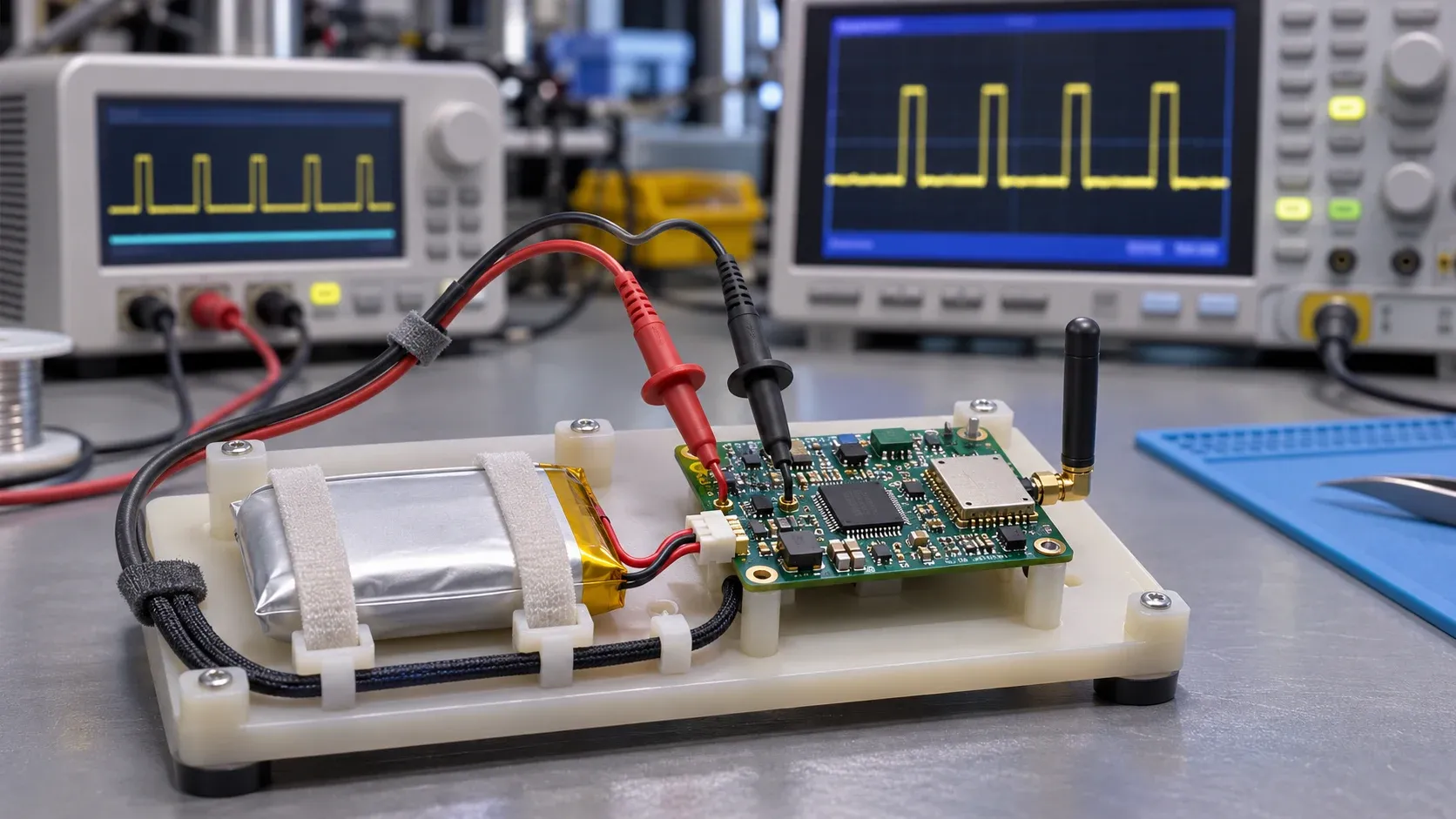
Illustrative radio-pulse validation setup; waveforms do not report a measured voltage minimum or pass/fail result.
On representative low-SOC, cold and aged samples, log the pre-burst voltage, pulse minimum, recovery, MCU resets and protection events. Compare the minimum with the actual radio, sensor and regulator operating limits. A node can fail on a burst while charge remains. Analog Devices’ low-power systems discussion covers the roles of quiescent current, duty cycle and regulated voltage.
Choose between primary, rechargeable and harvested energy
Without a dependable charging path, compare primary-cell storage life, pulse capability, usable capacity and replacement logistics. With a controlled charging source and a thin enclosure, a Li-Po pouch cell is a candidate; verify that model’s charge voltage, current, temperature, protection and mechanical limits. One cell’s nominal capacity cannot prove another cell’s years of service.
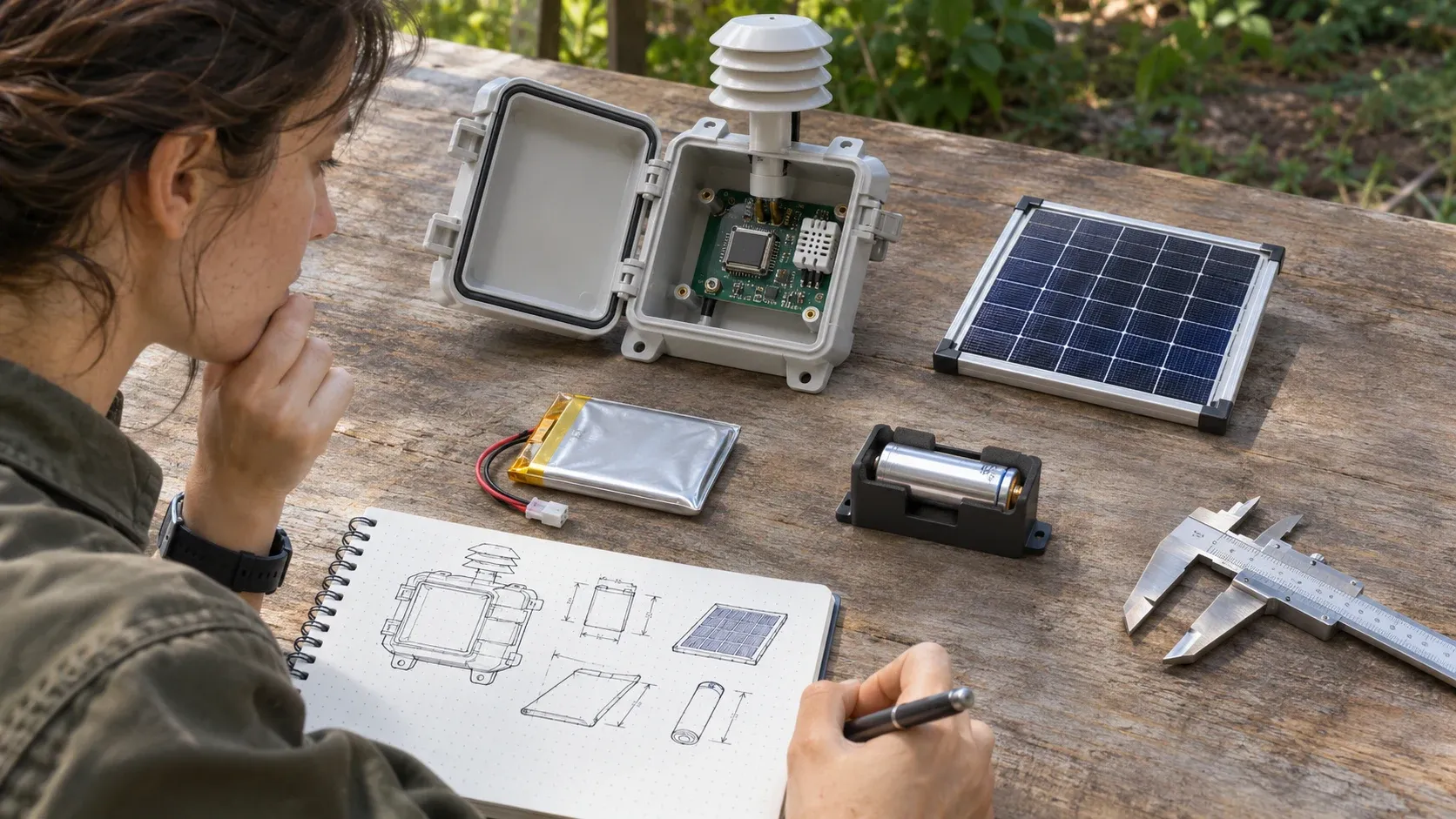
Illustrative comparison of primary, rechargeable and solar-assisted sensor power options; suitability requires model-specific and site-specific validation.
Measure harvest input at the intended location across season, shade and weather. TI’s single-cell solar charging reference design demonstrates one circuit, but its stated performance does not guarantee field energy. Size storage for the longest relevant low-input interval and validate charging limits when input returns.
Validation and supplier checklist
Test final board, firmware, protection and enclosure: whole-node sleep and reporting cycle; weak-signal retries, unexpected wakeups and firmware updates; minimum pulse voltage at low SOC and temperature; usable capacity, self-discharge, aging and lot variation; harvesting loss and recovery; warning thresholds and safe shutdown. Retain waveforms, sample counts, dates and failures. A single bench run is not a fleet-life guarantee.
For a supplier quotation, provide envelope, voltage, event rate, state currents and durations, signal conditions, temperature range, service target, charging method and volume. Request model-specific capacity, pulse, charging and transport information, then confirm on the assembled node.
FAQ
Can I divide rated mAh by average current?
Only as an early approximation. Account for voltage and conversion losses, cutoff, temperature, aging, self-discharge and pulses. Device-side current is not automatically battery-side current.
Does lower sleep current always mean longer life?
No. TI shows that changing measurement frequency changes the balance between sleep and active current. Radio retries can dominate whole-node use.
Can harvesting remove maintenance forever?
No. Input varies by site and storage devices age. Verify low-input intervals, charging limits and protection.
Procurement & Engineering Solutions
Related Battery Categories & Manufacturing Capacities
Looking to evaluate specifications or request custom engineering samples? Explore our verified product lines below: